Canada Names Five Priority Grid Interties
Federal government identifies BC-Yukon, Alberta-BC, Alberta-Saskatchewan, Saskatchewan-Manitoba and PEI-New Brunswick connections for financial and regulatory support
© CleanTechnica
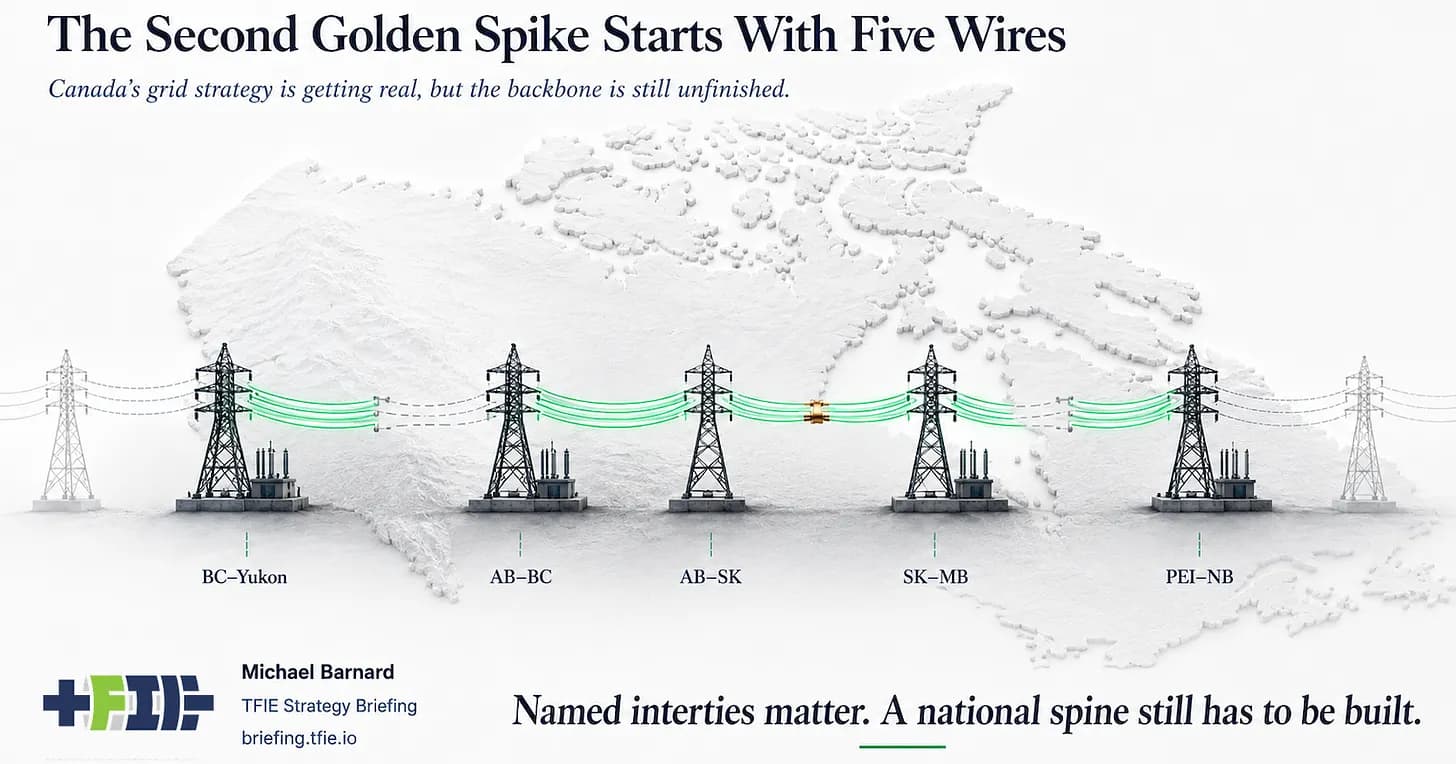
Canada's federal government announced five priority intertie projects on 12 June 2026 that will receive financial and regulatory support as part of a national strategy to double the country's electric grid capacity by 2050. Energy Minister Tim Hodgson made the announcement at the Energy and Mines Ministers' Conference 2026, identifying transmission connections across British Columbia-Yukon, Alberta-British Columbia, Alberta-Saskatchewan, Saskatchewan-Manitoba and Prince Edward Island-New Brunswick.
The five projects represent the first tranche of a broader grid expansion programme supported by a federal commitment of $60 billion linked to the National Energy Corridor Agreement. The federal government also established a Federal-Provincial-Territorial Framework on Interties with a standard cost allocation mechanism to govern project development. Ten provinces and territories signed the National Energy Corridor Agreement, with Quebec signing provisionally, aiming to connect Canada's isolated regional grids into a unified system.
BC-Yukon Grid Connect
The BC-Yukon Grid Connect will deliver an approximately 800-kilometre high-voltage direct current transmission line operating at 200 kV or higher to support the critical minerals sector in northern Canada. Natural Resources Canada committed $40 million to the project, which is designed to extend grid electricity to northern communities, mines and industrial projects currently dependent on diesel generation. The line will reduce fuel dependence in remote areas where distance, loads and construction costs justify grid extension.
Alberta Interties
The Alberta-BC intertie will restore transmission capability and increase electricity trade between the two provinces by approximately 150 MW. The Alberta-Saskatchewan intertie will replace the McNeill converter station near Medicine Hat and increase trade capacity by approximately 250 MW. Both projects are intended to expand Alberta's clean import and export options, improve system balancing and reduce the province's grid isolation during stressed periods. Alberta operates a competitive electricity market and maintains a grid materially dependent on natural gas alongside growing renewable resources.
Saskatchewan-Manitoba Intertie
The Saskatchewan-Manitoba intertie will expand transfer capability by up to 2 GW along the Regina-Winnipeg corridor. Manitoba operates flexible hydroelectric generation while Saskatchewan has a fossil-heavy grid with substantial wind and solar potential. The increased connection capacity is designed to allow hydroelectricity to balance variable renewable generation, move clean surplus power when it has value and reduce the amount of backup capacity each province must maintain separately. The project's value will derive from changed system operation rather than from the transmission line itself.
PEI-New Brunswick Connection
The Prince Edward Island-New Brunswick project will install new subsea cables to reinforce transmission linking PEI, New Brunswick and Nova Scotia. The connection addresses Maritime reliability, subsea cable vulnerability and the integration of Atlantic renewable resources into operational grid assets. The project is part of efforts to ensure transmission capacity, operating agreements and generation development arrive together in Atlantic Canada.
National Context and Build Order
Canada's electricity system is approximately 80 per cent non-emitting in aggregate but comprises sharply different provincial grids including hydro-rich provinces, nuclear-heavy Ontario, fossil-dependent Alberta and Saskatchewan, wind-rich Atlantic provinces and diesel-dependent northern communities. The country operates 20 major interties including 10 east-west and 10 north-south connections. Electricity demand growth is driven by industrial expansion, electric vehicles, heat pumps, data centres and artificial intelligence.
The five named projects do not close Canada's most important east-west gaps. Stronger Ontario-Quebec and Manitoba-Ontario connections remain absent from the initial priority list. Electricity remains provincial in law, regulation, utility ownership, system operation and politics. Ottawa can lower financing costs, adjust tax credits, use the Canada Infrastructure Bank, support Indigenous equity and place nationally significant projects into federal approval machinery but cannot order provincial utilities and regulators to operate as one system.
Each priority intertie requires definition of transfer capacity, expected annual energy flows, capital cost, cost allocation, avoided fossil generation, reliability contribution, permitting milestones, Indigenous ownership or benefit structures, target service date and the specific constraint each line resolves before the projects advance from policy intentions to operating electricity assets.
Sign up to our monthly HVDC newsletter
Join 10k+ energy professionals. Get the latest project updates, technology breakthroughs, and market analysis delivered monthly.
No spam. Unsubscribe anytime.