DOE Study Endorses North Plains Connector HVDC Project
Federal transmission needs assessment identifies 3,000 MW, 525 kV line connecting three US grid markets as critical interregional solution
© GazetteXtra
The North Plains Connector Utility Consortium has endorsed the US Department of Energy's 2026 National Transmission Needs Study following the study's explicit identification of the North Plains Connector as a transmission solution capable of addressing future capacity and reliability needs across multiple grid regions.
The study states that interregional transmission has the highest potential value to relieve transmission congestion and provide resource adequacy benefits. It notes that North Plains Connector can provide value by enabling cross-interconnection power transactions with generation resources that experience different weather patterns, allowing regions to share resources more efficiently and respond more effectively to changing system conditions.
Project Specifications and Market Integration
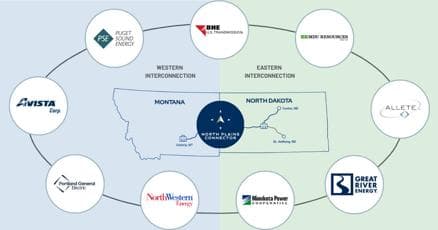
North Plains Connector is an approximately 420-mile, up to 525 kV high-voltage direct current transmission line with 3,000 MW bidirectional transfer capability. The line will run from Colstrip, Montana to two converter stations in central North Dakota near Center and St Anthony. The project will be the first US transmission system to directly connect three major grids: MISO, SPP and the Western Interconnection (WECC).
The line is designed to be open to all sources of electrical power generation and will be able to transport power in either direction. Approximately 2,550 MW of the 3,000 MW capacity is already subscribed. The project represents an investment of approximately $3.2 billion.
Reliability and Economic Value
The project's effective load-carrying capability has been assessed at approximately 3,550 MW total, exceeding its 3,000 MW rating due to seasonal load diversity across the connected regions. The DOE study attributes 1,800 MW of reliability value to WECC for winter reliability, 1,350 MW to SPP and 400 MW to MISO for summer peaks.
The Department of Energy's 2024 National Transmission Planning Study estimates that interregional corridors like North Plains Connector could reduce congestion costs by up to $490 billion through 2050. Grid congestion added approximately $12 billion to wholesale power costs in 2024, and cross-market transmission links offer a median value of approximately $35 per MWh compared to less than $20 per MWh for intra-market connections.
The Consortium stated that by connecting markets that currently operate in isolation, the project can strengthen reliability, improve system resilience, optimise the use of existing generation and transmission assets, and deliver long-term benefits to utilities, customers and the broader electric system. The ability to bridge interconnection seams between the Western and Eastern grids, which operate at different frequencies, enables resource sharing across diverse climatic zones to improve system resilience during extreme weather events.
The North Plains Connector Utility Consortium comprises ALLETE Inc, Avista, BHE US Transmission, Great River Energy, MDU Resources subsidiary Montana-Dakota Utilities, Minnkota Power Cooperative, NorthWestern Energy, Portland General Electric and Puget Sound Energy.
Sign up to our monthly HVDC newsletter
Join 10k+ energy professionals. Get the latest project updates, technology breakthroughs, and market analysis delivered monthly.
No spam. Unsubscribe anytime.